
Aluminum Die Casting Finned Heat Sink Housing for Power Electronics combines the enclosure wall with external cooling fins so heat can move from an electronic module into the surrounding air. Successful production depends on two connected requirements: the thin fins must fill without damage, and the module-contact surface must remain suitable for machining and thermal assembly.
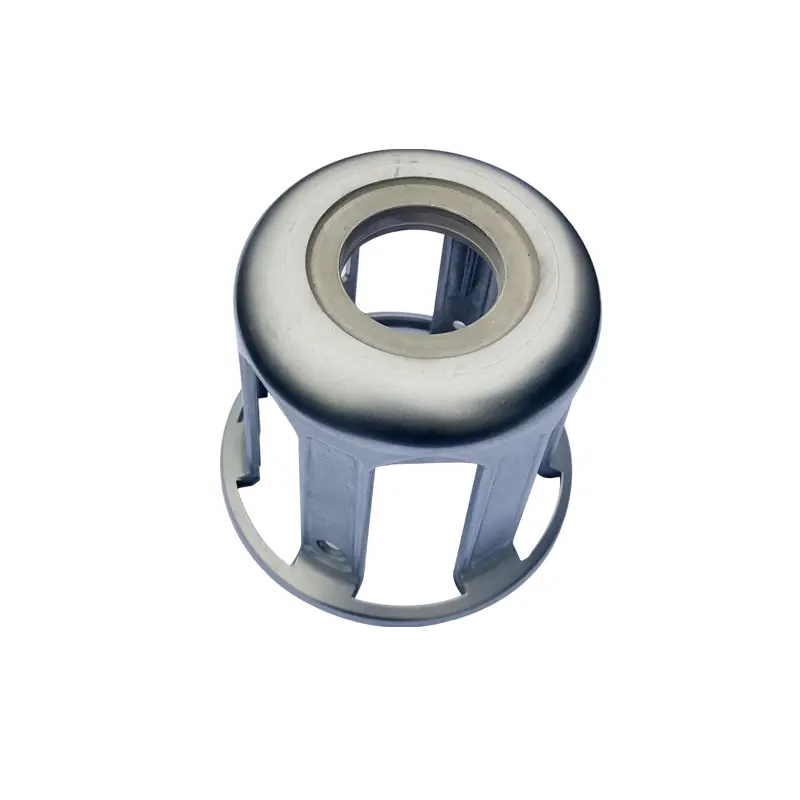
The customer’s thermal analysis determines fin area, orientation and contact requirements. Huabo uses that information for manufacturability review rather than replacing the thermal design. Fin height, spacing, draft, base thickness and airflow direction are examined together because a geometry that performs well in simulation must also fill, eject and remain dimensionally stable.
| Feature | Manufacturing concern | DFM response | Inspection |
|---|---|---|---|
| Thin cooling fins | Incomplete fill, bending or die sticking | Review flow direction, draft, venting and ejection support | Visual fill check and fin gauge |
| Thick thermal base | Shrinkage and internal porosity | Balance thickness transitions and position gates/overflows from flow analysis | Section or nondestructive test when specified |
| Module contact pad | Warp or insufficient machining cleanup | Define local flatness, stock allowance and fixture support | Surface plate, profile equipment or CMM |
| Mounting holes | Position error relative to contact area | Machine critical features from the thermal-interface datum | CMM or dedicated fixture |
| Coated housing | Coating insulates the thermal or grounding interface | Mask specified pads and threads | Post-finish fit and visual check |
Long thin fins create flow resistance and increase the risk of cold shuts at the ends. Adding metal temperature or injection speed without reviewing the complete system is not a reliable correction. Tool steel condition, venting, gate direction, overflow position and die temperature balance all contribute. Draft and ejector support also matter because a completely filled fin can still be bent during release.
The surface beneath a power module, LED board or thermal pad may require local flatness and surface-finish control. The drawing should identify the exact contact zone instead of applying a tight value to the entire casting. Huabo reviews machining allowance so the surface cleans up without an unnecessarily deep cut that exposes porosity or reduces base thickness.
Review the thermal model, 2D drawing and mating module interface.
Confirm the specified alloy and whether conductivity, strength, corrosion or appearance drives selection.
Develop gating, venting, overflow, cooling and ejection for the fin direction and base mass.
Die cast, trim and deburr while protecting fins from impact.
Machine contact pads, mounting holes, threads and connector openings from the functional datum.
Clean the housing and mask thermal, grounding and precision-fit areas.
Apply the specified finish and inspect the part in its final condition.
Pack with fin protection suitable for export handling.
Painting or powder coating may improve appearance and environmental resistance but adds an insulating layer. The customer should define whether fin surfaces are coated and which contact pads remain bare. If anodizing or conversion treatment is requested, alloy compatibility and cosmetic expectations are reviewed. Huabo controls masking edges so coating does not intrude into module-contact or grounding zones.
First-article inspection covers the contact datum, mounting pattern, fin envelope, housing wall and connector interfaces. Production checks focus on fin damage, incomplete fill, base flatness, hole position and thread quality. A go/no-go fin fixture can provide rapid feedback, while CMM or profile measurement verifies the thermal-interface relationship after tooling or machining changes.
Cooling fins can pass inspection and then be damaged by bulk handling. Tray, separator or compartment packaging is selected according to fin geometry, finish and shipment quantity. Contact pads receive protection from scratches and contamination when they will mate with a thermal pad or electronics module.
Send 3D and 2D files, thermal-interface drawing, alloy, annual volume, finish, critical flatness and surface-finish requirements, coating masks and packaging expectation. Related support includes aluminum die casting, CNC machining, surface finishing and dimensional inspection.
Can all cooling fins be produced without machining?
Fins are normally cast when geometry and draft permit. Their manufacturability depends on length, thickness, spacing, flow direction and tool release.
Should the module contact surface be machined?
The decision depends on local flatness, surface finish and thermal-interface material. The functional contact zone should be identified on the drawing.
Can the housing be supplied with coated fins and bare mounting pads?
Yes. The finish drawing can define masks for thermal pads, grounding locations, threads and other precision interfaces.
 RELATED
RELATED
RELATED
 RELATED
 RELATED
Tel: +86 18868921505
Email: lijianguo@cxhuabo.com
Address: Yiheng Road, Changhe Town, Cixi City, Ningbo, Zhejiang Province, China

Scan wechat
Copyright © 2022 Cixi Huabo Machinery Co., Ltd
SitemapThis website uses cookies to ensure you get the best experience on our website.

 Español
 Pусский
 Français
 日本語
日本語



 WhatsApp
 Phone
Phone