
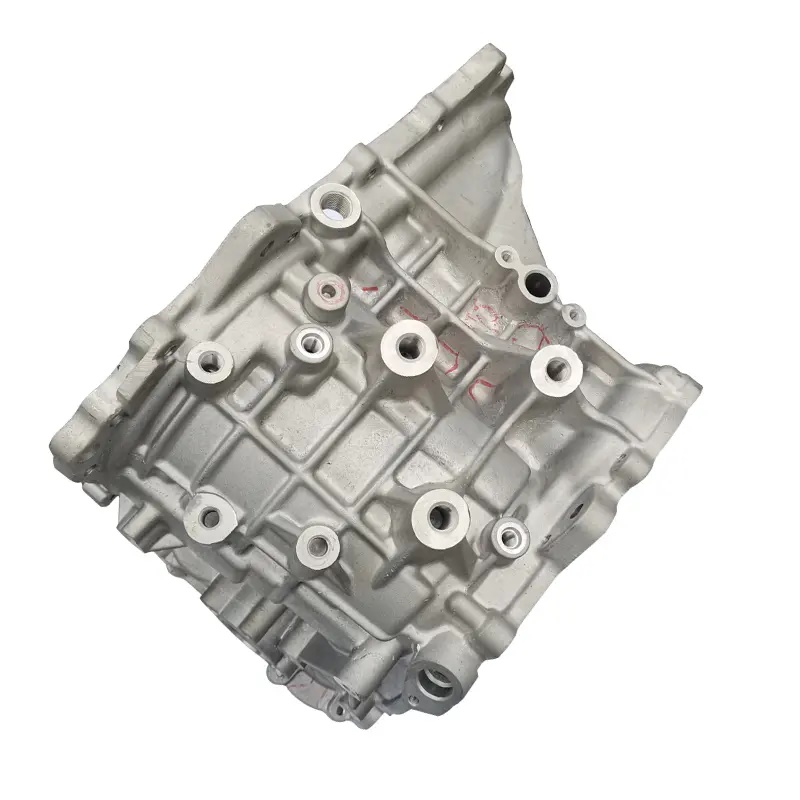
Aluminum die casting is most useful when an OEM part needs repeatable shape, ribs, bosses, mounting features or enclosed geometry that would be inefficient to machine from solid material. The practical question is not simply whether a part can be cast. It is whether the casting layout can support the functional faces, hole locations, wall transitions and appearance zones that matter after assembly.
For a new program, Huabo reviews the drawing together with the intended production route: casting, trimming, machining, surface finishing and inspection. This helps separate features that should be formed in the die from features that should be machined after casting. That decision affects tool complexity, dimensional stability and quotation accuracy.
| Project input | Why it matters before tooling |
|---|---|
| 3D model and 2D drawing | Shows draft-sensitive walls, ribs, bosses, parting-line candidates and machining datums. |
| Alloy requirement | Confirms whether ADC12, A380 or another specified aluminum alloy is suitable for the part function. |
| Critical dimensions | Identifies bearing areas, mounting faces, hole positions, threads and sealing-related surfaces. |
| Surface requirement | Clarifies whether the part needs deburring, blasting, painting, powder coating or protected machined areas. |
| Forecast quantity | Helps evaluate cavity layout, tooling investment, batch planning and packaging. |
A good die casting drawing leaves room for both processes. Features such as hidden undercuts, deep narrow ribs or abrupt wall changes can affect filling and ejection. Functional flatness, thread depth and precision hole position are often better controlled after casting from defined datums. The casting should therefore provide stable material where machining is needed, while avoiding unnecessary machining on non-functional surfaces.
During production planning, attention normally goes to gate and overflow locations, trimming access, machining allowance, fixture reference points and protection of visible surfaces. For assemblies, the acceptance criteria should distinguish between general casting appearance and dimensions that affect fit or performance.
Inspection is most effective when the drawing identifies which features are critical to function. A housing may require checks on a gasket land and mounting face; a bracket may need hole position and flatness; a heat-management part may need fin completeness and a flat contact surface. General outside dimensions alone do not explain whether a die cast part will assemble correctly.
Read more about aluminum die casting service, CNC machining after casting and dimensional inspection for die cast parts. For machinery-oriented applications, see industrial machinery die casting parts.
Send the latest drawing revision, material preference, tolerance notes, machining requirements, finish, annual volume and packaging expectations. Where a sample or mating component is available, describe the interface that the casting must achieve. That gives the engineering review a concrete basis and reduces late tooling changes.
 RELATED
 RELATED
 RELATED
 RELATED
Tel: +86 18868921505
Email: lijianguo@cxhuabo.com
Address: Yiheng Road, Changhe Town, Cixi City, Ningbo, Zhejiang Province, China

Scan wechat
Copyright © 2022 Cixi Huabo Machinery Co., Ltd
SitemapThis website uses cookies to ensure you get the best experience on our website.

 Español
 Pусский
 Français
 日本語
日本語



 WhatsApp
 Phone
Phone