
Precision ADC12 Aluminum Die Casting Machinery Housing with CNC Machining combines a near-net-shape casting with accurately machined bearing seats, shaft locations and mounting faces. The main engineering challenge is not creating each feature separately. It is maintaining their relationship after the housing cools, releases from the die and is clamped for machining.
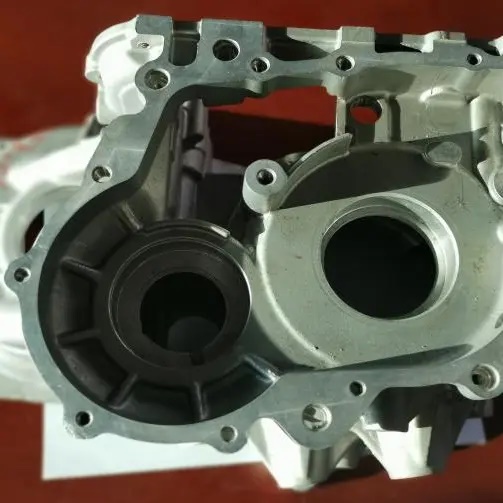
Huabo begins by identifying the rotating, sealing and mounting functions. Bearing bores may require positional or coaxial control; a flange face may define the primary assembly datum; threaded bosses may only provide fastening. Separating these functions prevents the drawing from assigning unnecessary precision to cast ribs while leaving the real alignment chain unclear.
| Characteristic | Manufacturing risk | Control approach | Inspection |
|---|---|---|---|
| Bearing bore | Position shift or interrupted cleanup | Tooling allowance and machining from the functional datum | Bore gauge and CMM relationship check |
| Two shaft locations | Misalignment increases noise or wear | Machine in one setup where geometry and equipment permit | Coaxiality or position evaluation per drawing |
| Sealing flange | Porosity exposed by machining or local distortion | Review cut depth, heavy sections, gate and venting | Flatness, surface coverage and specified leak test |
| Mounting pads | Housing rocks in the customer assembly | Define primary, secondary and tertiary datums | Fixture, surface plate or CMM |
| Threaded boss | Tool wear, burr or insufficient depth | Controlled drilling/tapping with chip removal | Thread gauge and depth check |
Adding excessive stock does not automatically improve quality. A deep machining cut increases cycle time and may expose subsurface porosity; insufficient stock can leave unmachined areas when the casting shifts or distorts. Huabo reviews the expected casting variation, datum contact and functional surface before setting allowance. The result is documented in the approved model and drawing.
The first machining setup establishes the reference used by later operations. Fixture supports are positioned on stable areas and clamping force is directed through stronger sections so the housing is not deformed during cutting. Where possible, related bores and faces are completed without unnecessary re-clamping. For a complex housing, a fixture concept may be reviewed during DFM because the part geometry must provide reliable locating and tool access.
Review the complete assembly stack and critical-to-function dimensions.
Confirm ADC12 or the customer-specified alloy and any leak, finish or cleanliness requirement.
Develop mold filling, venting, overflow and ejection around heavy bosses and bearing regions.
Die cast, trim, deburr and visually screen the housing before machining.
Machine datum faces, bearing bores, shaft features, threads and ports in the approved sequence.
Wash the part and protect internal passages from chips and abrasive residue.
Apply the specified surface treatment with masking for precision interfaces.
Complete dimensional, thread, appearance and optional leak inspection before packing.
Pressure die castings can contain internal pores, especially near heavy sections or poorly vented regions. The practical response is to reduce the cause during tooling and process development, limit unnecessary cut depth and define acceptance according to function. A cosmetic pore on a noncritical machined pad is evaluated differently from a connected leak path through a sealing wall. The customer should provide pressure and leakage limits when fluid containment is required.
A first-article report verifies the datum system, bearing features, mounting faces and overall envelope. CMM inspection is useful for relationships between separated features, but production control can combine bore gauges, thread gauges and dedicated fixtures for faster feedback. Gauge repeatability and the condition of the part during measurement should be agreed when tight geometric tolerances are involved.
Drawing revision, tooling condition, machining program and inspection records should remain linked to the production lot. When a bearing or seal interface changes, Huabo reviews the effect on casting allowance, fixtures and gauges instead of treating it as a simple drawing update. This is particularly important when the change alters the datum structure.
Provide the 3D model, controlled 2D drawing with datum and geometric tolerances, annual volume, batch quantity, alloy, surface finish, mating components and any leak or cleanliness standard. Huabo can quote ADC12 die casting, tooling, CNC machining, cleaning, finishing and CMM inspection.
Can bearing bores be produced directly by die casting?
A cast pilot can reduce material, but precision bearing seats are normally evaluated for machining according to tolerance, surface finish and alignment requirements.
How is bore alignment controlled?
The machining datum, setup sequence, fixture support and inspection method are planned as one system. Related bores may be machined in one setup where practical.
Can the housing be leak tested?
Yes, when the drawing defines test medium, pressure, duration and acceptance limit. The requirement must be reviewed before tooling because wall and machining design affect the result.
 RELATED
RELATED
RELATED
 RELATED
 RELATED
Tel: +86 18868921505
Email: lijianguo@cxhuabo.com
Address: Yiheng Road, Changhe Town, Cixi City, Ningbo, Zhejiang Province, China

Scan wechat
Copyright © 2022 Cixi Huabo Machinery Co., Ltd
SitemapThis website uses cookies to ensure you get the best experience on our website.

 Español
 Pусский
 Français
 日本語
日本語



 WhatsApp
 Phone
Phone