
Custom Aluminum Die Casting Machinery Cover with CNC Machined Mounting Features protects moving or sensitive equipment while providing accurate interfaces for bolts, bearings, cable entries or adjacent housings. Unlike a decorative sheet-metal guard, a die cast cover can integrate ribs, bosses, mounting pads and curved geometry in one part. Its success depends on how those features fill, cool and remain aligned after ejection and CNC machining.
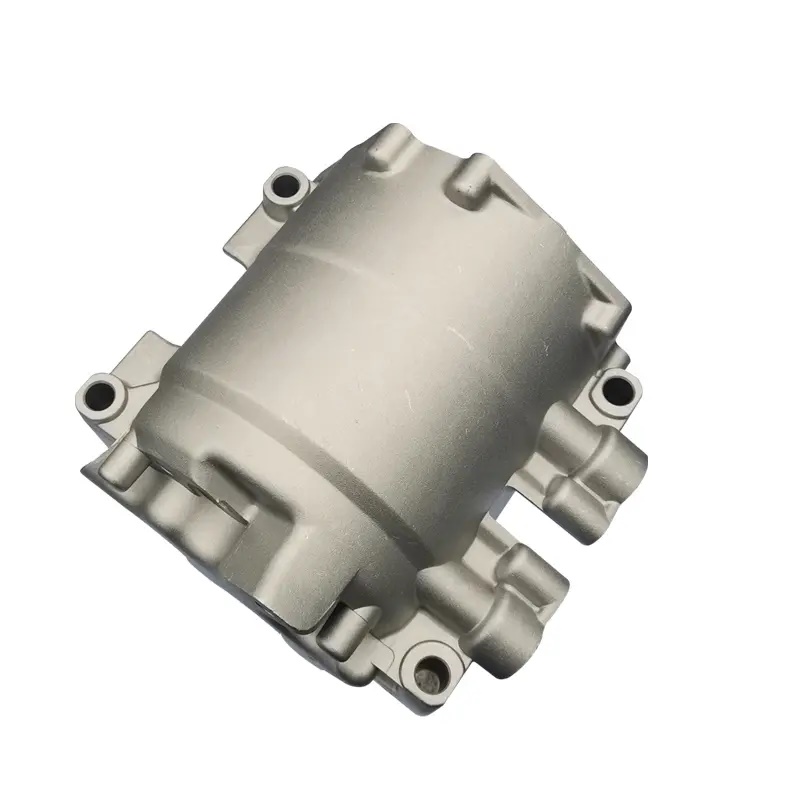
Before tooling, Huabo separates structural, sealing and appearance requirements. A cover that only keeps out debris has a different inspection plan from a cover that locates a shaft, supports a sensor or closes an oil-filled gearbox. The drawing should identify the mounting datum, permitted casting marks, sealing contact area and surfaces that remain visible to the equipment operator.
| Design area | Question reviewed | Production decision |
|---|---|---|
| Wall transition | Will a thick flange feed a thin cover wall without shrinkage or distortion? | Adjust transitions, local radii, overflow and gate position before mold release. |
| Mounting bosses | Can the boss accept machining and tightening load without cracking? | Review boss diameter, rib support, draft and machining stock. |
| Sealing perimeter | Is the sealing face cast, spot-faced or fully machined? | Define the datum and required cleanup area on the 2D drawing. |
| Visible surface | Where are gate, ejector and parting-line traces acceptable? | Agree appearance zones and finishing sample before mass production. |
| Service opening | Will cable entries and fasteners remain accessible after assembly? | Check mating parts and tool access during DFM. |
Review the cover together with the mating housing and fastener arrangement.
Select the specified aluminum alloy and confirm whether appearance, corrosion resistance or machining performance is the priority.
Design the tool around stable filling, venting and supported ejection instead of placing gates only where they are easy to trim.
Die cast, trim and remove flash without damaging the sealing edge or visible face.
Establish the primary datum and machine mounting pads, holes, threads and sealing features in a controlled sequence.
Clean the cover and apply shot blasting, painting, powder coating or another approved finish.
Inspect functional features and protect finished faces during packing.
The machining fixture should reproduce the way the cover is located in the assembly without clamping a flexible wall out of shape. Critical holes and mounting faces are preferably related to one stable datum system. When a cover has several isolated pads, the drawing should clarify whether they must be coplanar and how that condition will be measured. This prevents a part from passing individual dimensions while rocking on the customer assembly.
Machining can open pores that were not visible on the cast skin. Huabo therefore reviews cut depth near heavy bosses and sealing faces before tooling. If the cover contains oil, air or another fluid, the customer should specify the pressure medium, test pressure, holding time and acceptance criterion. Leak testing is then treated as a defined production operation rather than an assumption attached to the word “housing.”
Paint and powder coat can improve corrosion resistance and appearance, but coating buildup can also interfere with threads, grounding points and tight-fitting interfaces. The finish drawing should mark masking areas, acceptable color range, gloss requirement and the surfaces where hanging marks are allowed. For export packing, machined faces and coated cosmetic zones should not contact each other.
First-article inspection normally covers the mounting datum, hole positions, thread depth, local flatness, sealing-face cleanup and the complete outside envelope. Production checks are then assigned according to risk. Thread gauges and dedicated fixtures can support frequent checks, while a CMM report is useful for validating the full datum relationship after a tooling or fixture change.
Send the 3D model, controlled 2D drawing, alloy, annual demand, batch quantity, finish standard and mating-part information. Mark critical characteristics instead of applying a tight general tolerance to every surface. Huabo can combine aluminum die casting, CNC machining, surface finishing and inspection in one quotation.
Can the sealing face be left as-cast?
It depends on the gasket design, pressure requirement and casting geometry. The sealing interface should be reviewed during DFM and specified on the drawing.
How are visible defects controlled?
The customer defines the cosmetic area and reference standard. Gate traces, ejector marks, parting lines and coating appearance are then evaluated against that agreed zone.
Can inserts or threaded fittings be included?
Insert molding or post-installed hardware can be evaluated from the drawing, required pull-out load and production volume.
 RELATED
RELATED
RELATED
 RELATED
 RELATED
Tel: +86 18868921505
Email: lijianguo@cxhuabo.com
Address: Yiheng Road, Changhe Town, Cixi City, Ningbo, Zhejiang Province, China

Scan wechat
Copyright © 2022 Cixi Huabo Machinery Co., Ltd
SitemapThis website uses cookies to ensure you get the best experience on our website.

 Español
 Pусский
 Français
 日本語
日本語



 WhatsApp
 Phone
Phone