
A pipe elbow housing has a simple purpose: connect flow from one direction to another. In die casting, that simple purpose can become a complex manufacturing problem because the part combines curved flow geometry, port alignment, wall transition, threaded features and sealing surfaces.
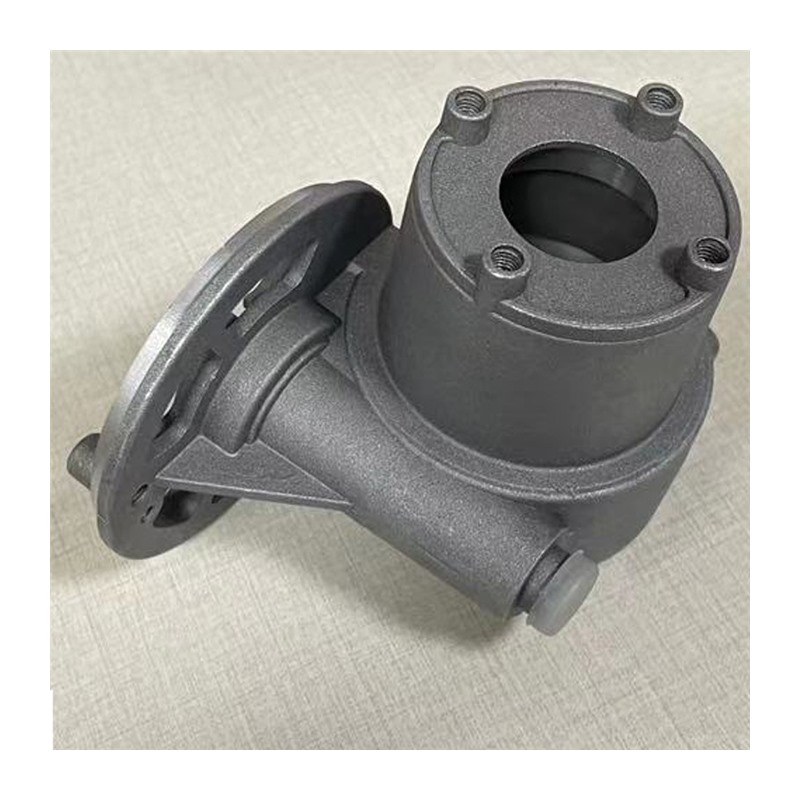
Buyers often send an elbow-shaped model and focus on the outer size. For a functional connector, the inner flow path is more important. The supplier needs to know whether the part carries air, water, oil or another medium, whether pressure is involved and whether the inside corner is only a passage or a sealing-critical area.
Sharp wall changes around an elbow can increase casting risk. Heavy sections near a port may create shrinkage, while thin edges around a threaded opening may be damaged during machining. A DFM review should balance strength, flow, machining stock and tool release direction.
| Feature | Possible risk | Control approach |
|---|---|---|
| Elbow transition | Uneven wall thickness and local shrinkage | Use smooth radius and balanced wall design |
| Threaded port | Poor thread fit or leakage after assembly | CNC machine or tap threads and inspect with gauge |
| Sealing face | Scratch, coating build-up or flatness issue | Define machined sealing area and masking if needed |
| Internal edge | Burrs may affect flow or cleanliness | Plan deburring access and inspection method |
| Mounting boss | Heavy local mass can create porosity | Review boss size, fillet and coring during DFM |
A thread note on the drawing is not enough. The supplier needs to know the thread standard, depth, whether sealing tape or an O-ring is used, and whether the thread is exposed to pressure. If the threaded area is coated after machining, masking or post-finish chasing may be needed to avoid assembly problems.
For export projects, the buyer should also state whether the thread gauge standard follows metric, BSP, NPT or a customer-specific requirement. Misunderstanding thread standards can create costly rework even when the casting itself is acceptable.
| Inspection item | Purpose | Evidence |
|---|---|---|
| Port center relationship | Ensures assembly with mating pipes | CMM or fixture measurement |
| Thread quality | Prevents loose fit or leakage | Go/no-go gauge and depth check |
| Sealing surface | Protects gasket or connector seal | Flatness, roughness or visual check |
| Internal cleanliness | Reduces burr and chip risk | Visual, air blow or customer-defined cleanliness check |
| Leak requirement | Validates pressure function if required | Leak test method and acceptance criteria |
Send the medium, pressure condition, thread standard, sealing method, annual quantity, surface finish and inspection requirement. If leak testing is required, state whether it is for samples only, every batch or every piece. This information changes fixture design, inspection time and final price.
Related product reference: Aluminum Die Casting Pipe Elbow Housing. Related pages: industrial machinery die casting parts, dimensional inspection and die casting process control.
Tel: +86 18868921505
Email: lijianguo@cxhuabo.com
Address: Yiheng Road, Changhe Town, Cixi City, Ningbo, Zhejiang Province, China

Scan wechat
Copyright © 2022 Cixi Huabo Machinery Co., Ltd
SitemapThis website uses cookies to ensure you get the best experience on our website.

 Español
 Pусский
 Français
 日本語
日本語



 WhatsApp
 Phone
Phone
Comment
(0)