
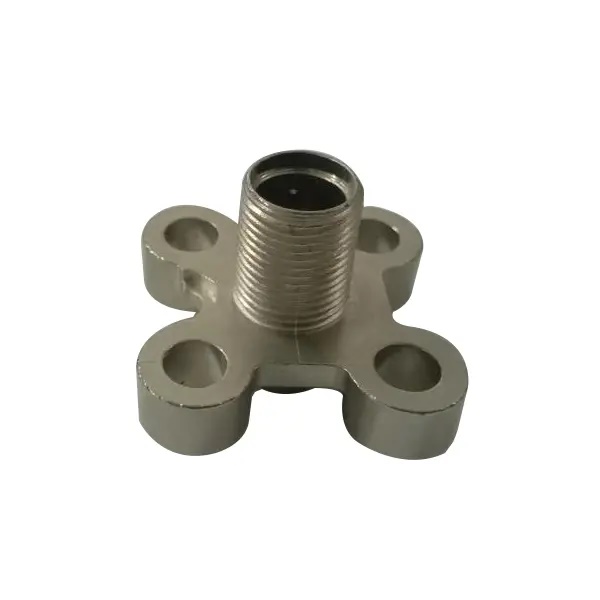
Zinc alloy is often the better choice when the part is small, detailed and used as a connector, cap, threaded fitting or compact assembly component. It is not selected because it sounds more advanced; it is selected because it can hold small features and surface detail well.
| Requirement | Zinc die casting | Aluminum die casting |
|---|---|---|
| Small threaded features | Often suitable | May require more machining allowance |
| Light weight | Not the main advantage | Usually better |
| Fine surface detail | Strong advantage | Depends on design and finishing |
| Large housing size | Less common | Usually preferred |
For connector parts, buyers should mark thread size, hole depth, mating surfaces and burr limits. If the part will be plated or coated, coating thickness around threads and contact surfaces should also be considered.
The most common risks are flash around small edges, thread damage after surface treatment and unclear acceptance standards for visible surfaces. These are avoidable when the RFQ includes a sample, drawing notes or a short inspection requirement.
See zinc die casting service and zinc threaded connector base for related product direction.
Zinc die casting is especially useful for compact parts that need small functional details. Connector bases, threaded fittings, caps and hardware parts often benefit from zinc alloy because the material can reproduce fine features with good surface quality.
Zinc parts are often plated or coated. The finish can improve corrosion resistance and appearance, but it can also affect threaded areas and tight mating features. If a connector must conduct electricity or fit into another component, the contact area should be marked clearly.
Typical zinc die casting applications include electrical connector bases, appliance covers, small machinery fittings, brackets and precision hardware. For similar parts, see custom zinc die casting connector bracket.
For zinc die casting connector parts, the thread is often the first place where a small manufacturing decision becomes an assembly problem. A thread that passes before plating may become tight after plating if the coating thickness is not considered. If the thread is a functional connection, buyers should specify whether threads must be masked, chased after plating, or checked with a go/no-go gauge after the final finish. This is more useful than simply writing "good quality thread" on a drawing.
When comparing two zinc connector quotations, check whether both include drilling, tapping, surface treatment and final thread inspection. One supplier may quote only the casting and visual deburring, while another includes machining and gauge checking. Those two prices are not equivalent. A fair comparison requires the same process scope.
| Question | Why it matters |
|---|---|
| Will the thread be machined after casting? | defines CNC cost and thread accuracy |
| Will the part be plated? | coating thickness can affect thread fit |
| Is the mating component available? | helps verify actual assembly, not only dimensions |
Tel: +86 18868921505
Email: lijianguo@cxhuabo.com
Address: Yiheng Road, Changhe Town, Cixi City, Ningbo, Zhejiang Province, China

Scan wechat
Copyright © 2022 Cixi Huabo Machinery Co., Ltd
SitemapThis website uses cookies to ensure you get the best experience on our website.

 Español
 Pусский
 Français
 日本語
日本語



 WhatsApp
 Phone
Phone
Comment
(0)